
Ascension Parish Arrest Records and Court Charges
Ascension Parish arrest records document the arrest or booking side of a case, such as the person taken into custody, booking identifiers, current custody status, and sheriff-held jail information when the person is housed locally. The Sheriff inmate inquiry can show current custody information, but the official corrections disclaimer warns that booking data may change quickly and may not reflect true charges, court date, status, or other case information. For jail roster and custody details, use the separate inmate-records path rather than treating a booking entry as the court case file.
Court charge records begin after law enforcement forwards the investigation and the 23rd Judicial District Attorney screens the matter. The District Attorney decides whether to prosecute and what formal charges to file. Once filed, those charges are processed by the Clerk of Court's Criminal and Minute Clerks Department and become part of the criminal court record. The full case file, including pleas, motions, hearings, disposition, and sentencing, is covered in Ascension Parish criminal court records.
Find Ascension Parish Arrest Records and Charges
There is no single official Ascension Parish page that merges arrest records, jail booking data, filed charges, and final criminal court outcomes. The access path is a chain. Booking and custody data start with the Ascension Parish Sheriff's Office inmate inquiry and records division. Filed court charges start with the Clerk Criminal and Minute Clerks Department after the District Attorney submits formal charges. Parish Court may handle many misdemeanor and traffic matters, while the 23rd Judicial District Court handles broader felony and criminal jurisdiction.
- Check the sheriff custody channel first if the question is whether a person is currently booked or in custody.
- Use Clerk e-services, Clerk Online Access, eClerksLA, or public access computers for filed charge and court case records.
- Search by defendant name, case number, date range, or court after identifying whether the case is District Court or Parish Court.
- Read the filed charge list, charge status, minutes, disposition, and sentencing entries before treating the record as final.
- Contact the Criminal and Minute Clerks or the District Attorney when the record needs official status confirmation.
The District 23 Public Defender is part of the same criminal-case system because counsel may appear once charges are filed. The manifest source for the 23rd Judicial District Public Defender shows indigent defense coverage across Ascension, Assumption, and St. James.

Defense representation is useful context when a charge record shows an appointed attorney, public defender, plea setting, or court appearance.
Ascension Parish Charges After Arrest
The charge record starts when a formal charging document places allegations before the court. Research confirms the District Attorney screens completed investigations and prosecutes crimes in the 23rd Judicial District. The exact label on the charging document can vary by case, but the concept is the same: a booking allegation is not the final court charge until the prosecuting authority files or accepts charges in court.
| Complaint | Information | Indictment | |
|---|---|---|---|
| Filed By | Officer or prosecutor, depending on the matter. | Prosecutor. | Grand jury. |
| Common Use | Initial accusation or lower-level matter. | Many prosecuted criminal cases. | Serious felony matters. |
| Record Role | Begins or supports a filed charge. | States the formal prosecuting charge. | Returns grand-jury charges for prosecution. |
| Where It Appears | Clerk criminal case file when filed. | Clerk criminal case file. | District Court criminal case file. |
Charge records can later change. A prosecutor can amend a charge, reduce a charge, add counts, dismiss counts, or decline further prosecution. The court record should be read through the latest disposition and sentence instead of stopping at the first charge entry.
District Attorney Charge Screening
The 23rd Judicial District Attorney's Office, led by Ricky L. Babin, prosecutes crimes in Ascension, Assumption, and St. James. Its judicial process starts with arrest, police reports, evidence, witness statements, and completed investigations being forwarded to the District Attorney. The DA screens the case and decides how to proceed. That screening step is central to Ascension Parish arrest records because it explains why the arrest side and the court charge side can differ.
The DA biography cited in the research reports a district scale of about 3,500 felonies and 24,000 misdemeanors annually. That number is district-wide, not an Ascension-only charge count, but it shows why formal charge processing is a large, separate stage after law enforcement booking.
The manifest had successful charge-record images for Louisiana appellate context. The Louisiana First Circuit Court of Appeal is relevant to the Baton Rouge region appeal path for many state trial-court matters.

Appeal context matters after a conviction, sentence, or order, but it does not replace the local Clerk record for the filed charge.
Ascension Parish Charge Status Terms
Charge status tells whether an accusation is still active, changed, dismissed, or resolved. Ascension Parish charge records should be read by count because one arrest can produce several charges, and each count can move differently. A charge can remain pending while another charge is dismissed. A plea can apply to one amended charge while other counts are dropped. A sentence belongs to the conviction or accepted plea, not to every allegation listed at booking.
| Status | What It Means |
|---|---|
| Pending | The charge is still open or awaiting further court action. |
| Amended | The filed charge was changed by prosecution or court action. |
| Reduced | The charge was lowered to a different or less severe allegation. |
| Dismissed | The court record shows the charge was removed or ended without conviction. |
| Nolle Prosequi | The prosecutor declined to continue that charge, subject to case-specific legal effect. |
| Convicted | A guilty plea or finding of guilt was entered on that charge or amended charge. |
Note: Always read the most recent docket and disposition before treating a charge as active or final.
Ascension Parish Charges vs Convictions
Being arrested, being charged, and being convicted are three different events. An arrest record shows custody or booking activity. A charge record shows what the prosecutor filed in court after screening. A conviction shows a guilty plea or finding. Ascension Parish arrest records may show booking charges that later differ from the filed court charges, so the court charge record and final disposition should control any status review.
| Charge | Conviction | |
|---|---|---|
| Meaning | A formal accusation submitted for prosecution. | A guilty plea or finding of guilt. |
| Timing | After arrest and DA screening. | After plea, trial, or final case action. |
| Can Change | Yes, it can be amended, reduced, dismissed, or dropped. | It can lead to sentence, appeal, or expungement review. |
| Where to Verify | Clerk criminal case file and docket. | Disposition, minutes, judgment, and sentencing entries. |
Sealed and Expunged Charge Records
Restricted charge records need careful handling. Juvenile delinquency and child-in-need-of-care matters are confidential without a valid court order. Sealed and expunged records are not ordinary public lookup results. The Clerk Criminal page links expungement forms, and Louisiana's expungement policy framework is tied to the balance between public access, law-enforcement needs, and employment opportunity. Eligibility depends on arrest, charge, disposition, sentence, waiting periods, and agency responses.
| Sealed | Expunged | |
|---|---|---|
| Public Access | Restricted from ordinary public view. | Removed from ordinary public access after court order. |
| Law Enforcement | May retain access under law or court order. | May retain access for legally allowed purposes. |
| Ascension Channel | Ask the Clerk or court about the sealing order. | Use Clerk criminal expungement forms and court process. |
| Safe Assumption | Do not assume public access. | Do not assume every agency record is unavailable. |
The Louisiana State Public Defender District 23 listing is another official source for the defense side of charge records in Ascension Parish.

Public defender office data helps locate representation resources when a filed charge appears in the court record but the defendant cannot afford counsel.
Charge Codes and Severity Levels
Charge codes connect a filed allegation to a statute, offense label, or court category. Ascension Parish court charge records may list felony or misdemeanor allegations, and some traffic-related matters may be handled in Parish Court. The severity level affects venue, bond, attorney appointment, plea negotiations, trial rights, sentencing range, and expungement analysis. The research did not expose a public Ascension charge-code table, so page copy should avoid inventing local code formats.
Federal or appellate systems are separate. The manifest includes the Louisiana Fifth Circuit Court of Appeal as an official appellate source, but local Ascension charge lookup begins with the Clerk, DA, Sheriff custody tools, and court that filed or heard the matter.
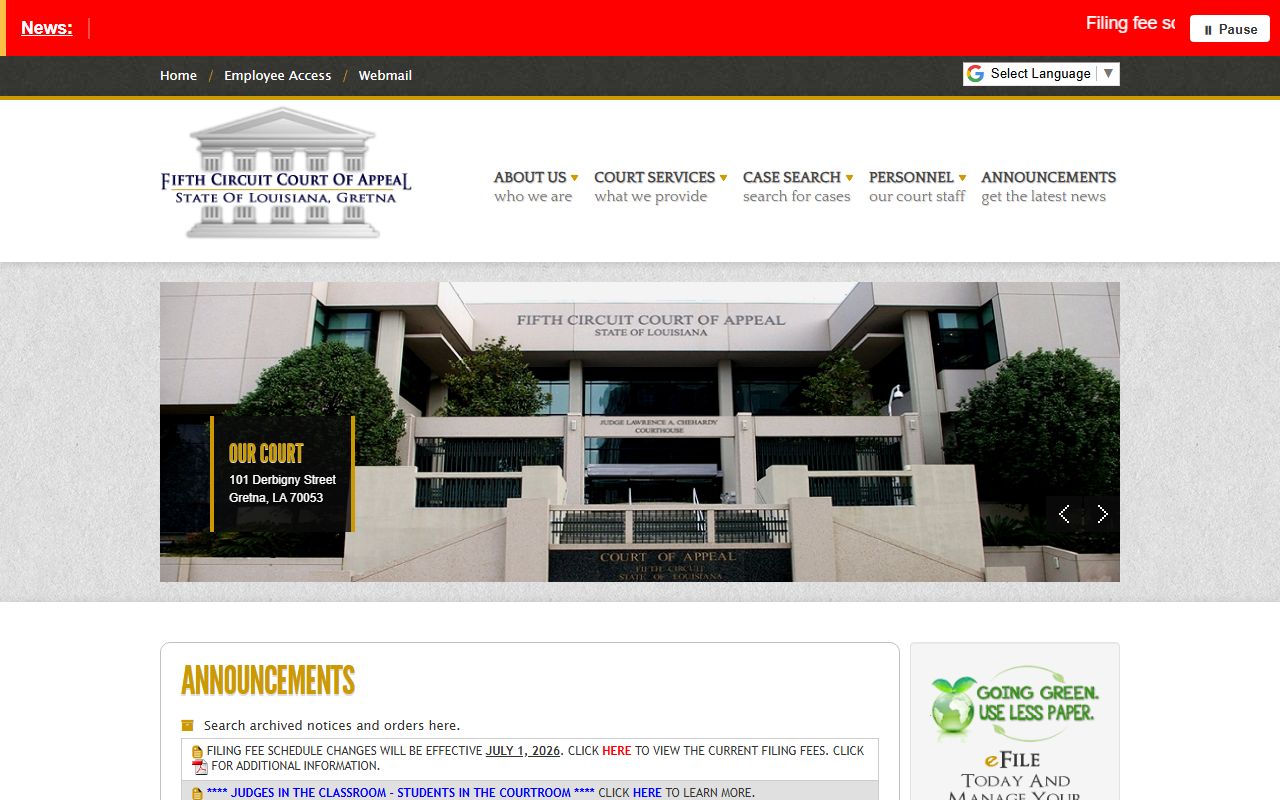
Appellate pages may help trace later review, but they are not substitutes for the local charge list, docket, and disposition.
Statewide Criminal History Limits
Statewide criminal-history tools are different from Ascension Parish arrest records and filed court charges. Research identified Louisiana custody and notification systems, including DPS&C, VINE, sex offender registry resources, and sheriff app features, but it did not identify a free statewide court-charge database that replaces the Clerk criminal record. Sentenced state prisoners are handled through Louisiana DPS&C resources, custody notifications through VINE, and sex-offender searches through the state registry. Those systems may answer custody or registry questions, not the exact filed charge history in a parish case.
The Sheriff's current mobile app advertises inmate search, sex offenders, jail information, tips, crime reporting, and news. The same research found no official app-only warrant or court charge lookup. For filed court charges after arrest, the Clerk Criminal and Minute Clerks Department remains the court-record route.
Restricted Ascension Parish Charge Records
Restricted Ascension Parish charge records include juvenile matters, sealed cases, expunged matters, protected victim details, confidential personal identifiers, and records limited by court order. Dismissed or reduced charges may still appear in a court file unless expunged or sealed, so a record should be read for both charge status and public-access status. The safest official path is to verify with the Clerk, the issuing court, or counsel before relying on a charge record for legal action.